Since early history, humans have been attracted to the exotic. In 16th century Europe, expanding overseas trading brought a fascination for oriental lacquerware. This, in turn, gave rise to a rich tradition by European craftsmen of imitating and paraphrasing these luxury items, using locally available materials and techniques. Although very different in their basic composition, these European lacquers replicated closely the glossy luxury of their Oriental equivalent. These so-called European lacquers remained popular until the early 20th century, after which the interest declined, due to the rise of synthetic polymers.
Through study of historical sources and physico-chemical analysis of museum objects and reconstructed mock-ups, the EUROPEAN LACQUER IN CONTEXT project (ELinC) aims to bring to light the history, techniques, materials and aging phenomena of European lacquer. The project focuses on its technological history, with an emphasis on those made in our regions and special attention to japanned objects in the collections of the Royal Museums of Art and History (RMAH). The lacquers will be characterized by joint efforts of art-historical, technological and chemical research. The project is funded by the Belgian Research Action through Interdisciplinary Networks (BRAIN.be), a framework programme for research, which is part of the Belgian Science Policy Office (BELSPO). This 4 year multi-disciplinary project (2014-2018) involves three Belgian and one foreign partner:
The Laboratory Department - Cell Paintings is responsible for the scientific analysis towards the composition of the European lacquers. The emphasis is placed on the organic composition, although the inorganic part (pigments, fillers, etc.) will not be neglected either.
This part of the project, as well as the entire ELinC project, is coordinated by Dr. Steven Saverwyns (KIK/IRPA). Louise Decq is carrying out her PhD in Chemistry within the project (promotors Prof. Dr. Frederic Lynen (UGent), Prof. Dr. Peter Vandenabeele (UGent) and Dr. Steven Saverwyns), with additional scientific support given by Dr. Wim Fremout (KIK/IRPA).
Work package 1 : Database design
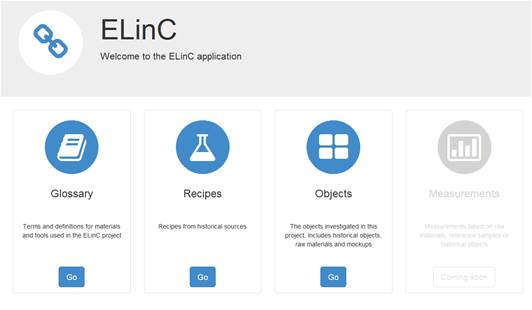
A large volume of information will be acquired during the research period: old recipes, data on ingredients that were used, results of scientific analysis, art-historical data, data on the objects from the Royal Museums of Art and History (RMAH) collection to be studied and so on. In order to manage all these data, and to facilitate sharing the information between the different partners (and in a later phase with the scientific community) a database is designed (figure 1). Emphasis is placed on the functionality of the database, making searching within the database and adding data easy and flexible. The concept of the database is designed taking into account wishes from the different partners working in different scientific disciplines. Data will be continuously added to the database by the different partners as the project progresses.
|
Figure 1. The ElinC database interface.
Work package 2 : Quality control
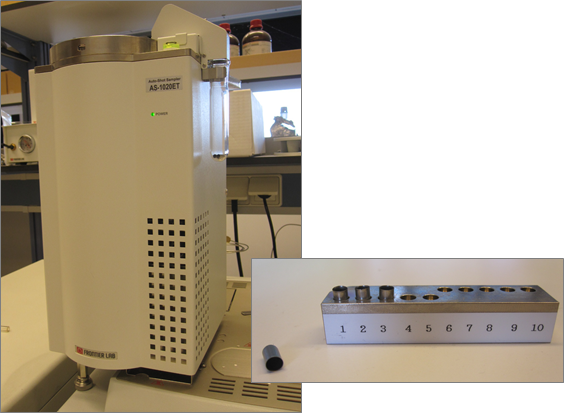
Resins in bulk quantity bought for the preparation of mock-up samples by the University of Antwerp, need to undergo quality control before they can be processed in European lacquers. Adulteration of resins or even deliberately replacing resins with cheaper varieties occurs; chemical analysis of all resins needed is the only way to guarantee the quality of the resins acquired. Fresh resins are systematically analysed by pyrolysis-gas chromatography coupled to mass spectrometry (Py-GCMS; figure 2), with thermally assisted hydrolysis and methylation (with TMAH). Results obtained are compared with reference samples and scientific literature. Only when a green light is given, these resins will be included in the mock-up samples.
|
Figure 2. Frontier Lab Multi-Shot Pyrolyzer (EGA/PY-3030D) equipped with Auto-Shot Sampler (AS-1020ET) to handle a large number of samples (left); deactivated stainless steel Eco-cups are used to hold the sample during pyrolysis (right).
Work package 3: Reference samples and Py-GCMS reference database
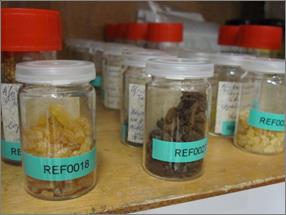
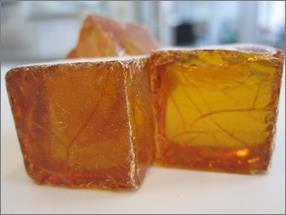
The resin reference samples (figure 3) are also used to build a Py-GCMS mass spectra reference database that will facilitate the identification of natural resins present in European lacquers. The pyrogram of each reference resin will be carefully scanned for (unique) biomarkers, which will be stored in a Py-GCMS reference database. As natural resins can change drastically in chemical composition upon ageing, biomarkers of aged resins are needed. For that purpose single resin varnishes, applied as thin films on glass slides, will be prepared by the University of Antwerp. Once dried, the samples will undergo artificial ageing in an Atlas weatherometer under controlled conditions of temperature, relative humidity and light intensity and wavelength range. By taking regularly samples, the ageing process van be followed in time, and the chemical changes in composition monitored. At the end aged resins containing (unique?) biomarkers are obtained, which will be fed to the Py-GCMS database, which in turn will facilitate the identification of the natural resins in the European lacquers. As the screening of a pyrogram takes much time, efforts will be done by using AMDIS (Automated Mass Spectral Deconvolution and Identification System) to (partially) automate the identification process.
|
|
| Figure 3. Part of the resin reference collection. | Figure 4. Resin in bulk quantity for the preparation of mock-up samples. |
Work package 4 : Analysis protocol
 To further optimise the analysis protocol (see also website of the Getty Conservation Institute, GCI) mock-up samples of European lacquers will be
prepared by the University of Antwerp, based on recipes mentioned in historical treatises and recipe books on European lacquering published from the 16 th century onwards. These lacquer mock-up samples will be artificially aged upon which the mechanical and physical tests will be carried out.
These aged samples will also be used to evaluate the Py-GCMS reference database and the analysis protocol developed by the GCI for Asian lacquers and to adjust it according to the needs. Besides analysis of the organic part
with Py-GCMS, also imaging-FTIR will be evaluated to get basic information on the organic composition. To complete the study inorganic compounds will be
determined by analysis with scanning electron microscopy with energy dispersive X-ray detection (SEM-EDX) and micro-Raman spectroscopy.
To further optimise the analysis protocol (see also website of the Getty Conservation Institute, GCI) mock-up samples of European lacquers will be
prepared by the University of Antwerp, based on recipes mentioned in historical treatises and recipe books on European lacquering published from the 16 th century onwards. These lacquer mock-up samples will be artificially aged upon which the mechanical and physical tests will be carried out.
These aged samples will also be used to evaluate the Py-GCMS reference database and the analysis protocol developed by the GCI for Asian lacquers and to adjust it according to the needs. Besides analysis of the organic part
with Py-GCMS, also imaging-FTIR will be evaluated to get basic information on the organic composition. To complete the study inorganic compounds will be
determined by analysis with scanning electron microscopy with energy dispersive X-ray detection (SEM-EDX) and micro-Raman spectroscopy.
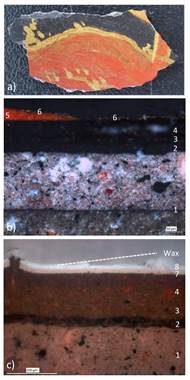
Figure 5. a) Detached sample with European lacquer from an object of the collection of the RMAH of which a small part at the intersection between the black and red lacquer was used to prepare the cross-section b) Detail of the cross-section under white light, showing a tinted thick ground layer (1), followed by a few dark coloured lacquer layers (2-4), a red lacquer layer (5) and gold foil (6) c) Another detail of the same cross-section, but under UV-light, showing clearly two final transparent lacquer layers (7-8) and a wax layer.
Work package 5 : Analysis of historical European lacquers
Finally the optimised analysis protocol will be applied on European lacquers originating from objects of the collection of the RMAH. Chemical data will be complimented by data from the technological and the art-historical research, and by studying a large number of objects from different time periods (and different regional origins) information on the technological evolution of European lacquers should be obtained.
|
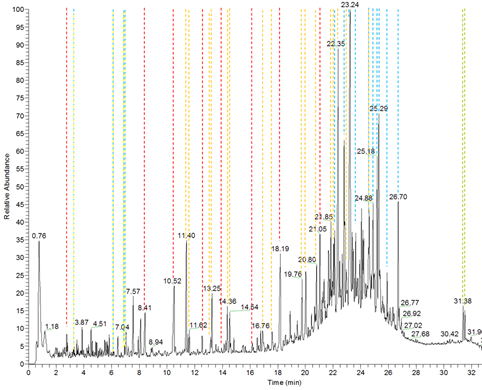
Figure 6. Typical Py-GCMS pyrogram of a European lacquer sample. Each peak in the pyrogram corresponds to a certain chemical compound. All peaks indicated with a dashed line of the same colour point to chemical compounds originating from the same resin. In this sample at least 5 different ingredients in the European lacquer can be noticed.
The University of Antwerp is responsible for the technological, physical and mechanical characterisation of European lacquer recipes. The main focus of this research is the understanding of certain degradation phenomena which have a direct influence on the physical appearance of European lacquers.
This part of the project is coordinated by Charles Indekeu and is executed by PhD-student Vincent Cattersel (doctoral supervisory committee: chair: Prof. Dr. Nick Schryvers; promotors: Dr. Guy Bovyn, Dr. Joost Caen; advisors: Dr. Emile Vanbinnebeke, Dr. Steven Saverwyns)
Work package 1: Technological characterisation
The technological characterisation of Work package 1 aims to gain valuable information on the rise and the evolution of European lacquering traditions concerning the use of materials, the techniques and recipes. Therefore, historical treatises and recipe books on European lacquering from the 16 th c. onwards are collected and studied.
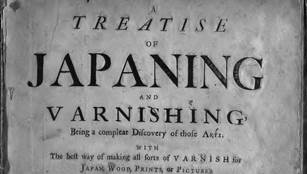
Fig. 1: First page of Stalker and Parkers’ 'Treatise of Japaning [sic] and varnishing', 1688.
The recipes and their material technical aspects such as ingredients (i.e. resins, gums, oils), tools and techniques are entered into a database. The database was designed for the ELinC-project and is frequently updated and subdivided in the following three object categories:
1. Glossary: includes ingredients, products, production tools and their respective synonym(s).
2. Recipes: includes historical European lacquer recipes. Furthermore, the ‘Recipes’ object category also includes references of historical sources on European lacquer.
3. Objects: includes all bulk materials that were acquired for the reproduction of single and complex varnishes.
A methodology has been designed to formulate the historical recipes into short and clear step-by-step instructions. In the recipe section, direct hotlinks give access to the items collected in the ‘Glossary’ and their respective historical source(s). The main purposes of this database is to centralise the collected data and making it available for all ELinC-partners and further research later on.
Work package 2: Reconstruction of historical recipes
Based upon Work package 1, mock-up samples of both ingredients and historical recipes will be produced. Mock-up samples are single or multi-layered films of pure ingredients or historical recipes of European lacquer on a glass or a plywood substrate.
As the mock-ups will serve for physical and mechanical tests throughout the whole project, they are measured before, during and after artificial ageing.
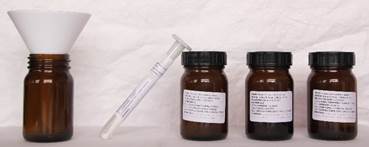
Fig. 2: Four spirit based mixtures before they are strained and combined to the final product 'To make the best White-varnish’ of Stalker and Parker (1688, pp. 10-11).
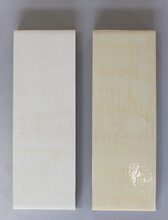
Fig. 3: Two mock-up samples in two different stages of production. Left, a mock-up sample with a white lead white ground layer before varnish application. Right, after application of 6 layers varnish of the Stalker and Parkers' recipe 'To make the best White-varnish’.
Work package 3: Mechanical and physical tests and imaging
The mechanical and physical tests concern the registration and study of hardness, colour, gloss, and their evolution throughout ageing. All tests are conducted under standardised ambient laboratory conditions (23 ± 2°C, 50 ± 5% RH).
· Hardness will be measured by a Pendulum hardness tester and the Wolff-Wilborn test (pencil hardness test).
· Gloss will be measured by a gloss- and DOI (Distinctness of Image) meter. This device can also characterise the full goniometric profile of the mock-up sample.
· Colour will be measured by a UV-VIS spectrophotometer.
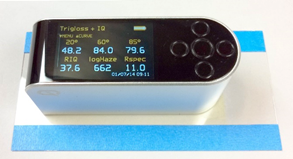
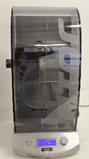
Fig. 4: Left, gloss and doi-measurements on a mock-up sample. Right, the pendulum hardness meter (König pendulum).
During this research photo documentation at macro level as well as using optical microscope imaging are carried out.
Furthermore, the use of state-of-the art imaging techniques are explored and will be used when they can attribute to the understanding and characterisation of surface and subsurface degradation phenomena. Possible inter-university collaborations are with the Catholic University of Leuven (KUL), for their Reflectance Imaging for Cultural Heritage-project (RICH) and the Technical University of Denmark for their Terahertz Reflectometric Imaging.
The obtained results will be compared and contextualised with observable degradation phenomena from the lacquerware objects preserved at the KMKG-MRAH.
Royal Museums of Art and History : responsible for the art-historical aspects of the research
The Royal Museums of Art and History of Belgium (RMAH) are responsible for the art-historical wing of the project. Attention is given to the lacquered furniture and objects kept in the museums which until now haven’t been really considered for their surface finishing. The aim of the research in not only to investigate the objects, the production sites and processes, but also to get a better insight in the socio-economic conditions in which the European lacquers were created and marketed. Special attention is given to the Belgium context.
This part of the project is coordinated by Dr. Emile van Binnebeke, curator of the European Sculpture and Furniture section of the Cinquantenaire museum, and conducted by Dr. Delphine Steyaert, scientific researcher for the project.
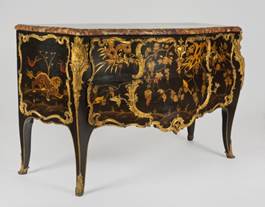
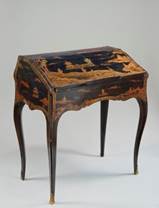
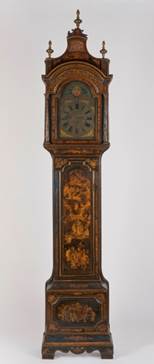
Fig. 1-3
1. Commode stamped by the French cabinemaker Charles Joseph Dufour (received as master in 1759).
2. Secrétaire de pente, Louis XV style, stamped I.P. LATZ.
3. Long Case Clock, around 1770-1790. Bronze dial by the clockmaker Aegidius Rousseau of Brussels. The case is probably English.
Work package 1: Inventory
An inventory of the lacquered objects and furniture has been made in the different sections of the RMAH, including the Musical Instruments Museum (MIM). The selection of around sixty pieces comprises a great variety of objects types dating from the 18th and 19th century.
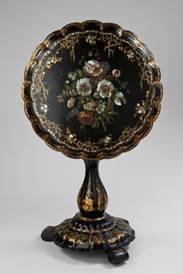
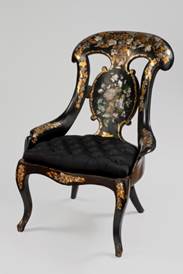
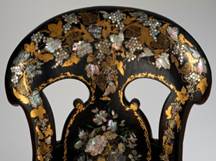
Fig. 4: Gueridon and armchair, partially in papier-mâché, with mother of pearl incrustations. English or French, c. 1850.
A commode by Charles Joseph Dufour (1740-1780), two secretaries, one bearing the stamp of Jean-Pierre Latz (c. 1691 –1754), a long case clock, an ensemble of black furniture, partially in papier-mâché and some Spa woods form an interesting whole for the study of japanned black furniture. Sledges, carriages, sedan chairs but also a piano, two harps and small precious objects in wood, metal or papier-mâché will also be considered. The provenance of these objects is wide. They come from our regions, but also from France, England, Austria and Italy. The works, which were donated or acquired mainly in the course of the 20th century, form indeed a heterogeneous whole, but are definitely representative of the European production.
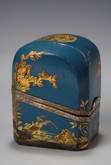
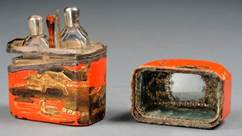
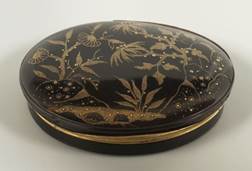
Fig. 5-7
5-6. Toilet bags, lacquered metal, c. 1760-1775, France?
7. Small box, lacquered tortoiseshell with small gilded metal incrustations, end 18th c. – beginning of the 19th c., provenience unknown (Italy?)
A table of Pierre Gole (c. 1620-1685) owned by the city of Antwerp, a cabinet attributed to Dagly from a private collection and some lacquered wood pieces of the Musées de la ville d’eaux of Spa were added to fill the gaps for the chronological study.
Work package 2: historical context
The emphasis of the historical research on archives is put on the 19th century production and market of japanned furniture and objects in Belgium, and more specifically in Brussels. If time allows, the research will be expanded to the 18th century in Brussels, at the time of Charles of Lorraine, governor of the Austrian Netherlands from 1744 to 1780.
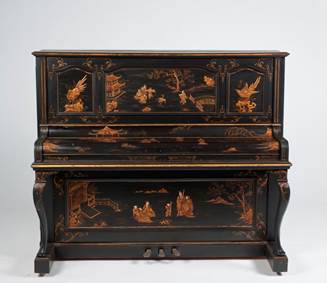
Fig. 8. Piano, J. Oor, Brussels, c. 1900.
Work package 3: recipes, patents
The study of the recipes and their reconstruction is an important part of the project. The RMAH team will collect biographical data on the authors and study the context of the publication of the treatises. Attention will also be given to the connection between the main recipes used for the technical and chemical study. We are currently investigating the 19th century patents in Belgium.
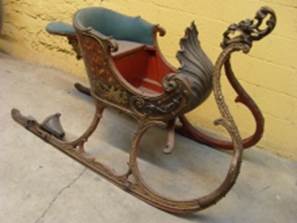
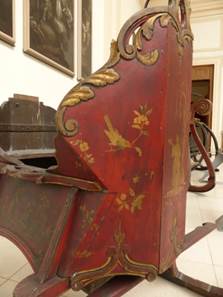
Fig. 9-10. Sledges
9. Liège, 2d half of the 18th c.
10. Holland or Friesland, 18th c.